
73. Earning Monetized Value Through Advanced Earning Systems
Article and discussion about advanced earning systems that let players earn monetized value in games in more effective ways than traditional earning systems work.

Most games already let players earn value. Players earn soft currency, hard currency fragments, materials, tokens, energy, event points, battle pass XP, loyalty points and many other forms of in-game value. They then use that value to buy, craft, unlock, accelerate, upgrade, convert, or progress toward something.
That’s the basic version of earning.
It works. It’s familiar. It’s understandable. And, in many games, it’s still one of the cleanest ways to connect engagement and monetization without forcing every valuable moment into a direct payment moment.
But, I think, the industry often stops too early here. Because, earning through in-game economy is only one way of letting players earn monetized value. It’s not the whole design space.
There are more advanced ways of doing the same thing:
Players can earn better offers.
Players can earn discounts.
Players can earn subscription access.
Players can earn VIP eligibility.
Players can earn premium tier openings.
Players can earn exclusive purchase rights.
Players can earn temporary monetized utilities.
Players can earn monetization surfaces themselves.
This differentiation matters. How? Because, once the monetized part of the game becomes earnable through gameplay, progression, meta systems, social systems, and feature engagement, monetization stops being only a store layer sitting on top of the game. It becomes part of the game’s progression language.
Not just:
Play → earn currency → buy item.
Instead:
Play → prove intent → unlock better commercial possibilities.
That is a very different design philosophy.
The Basic Model Is Currency Earning
The most common model is simple. The player plays the game, earns currency, and eventually spends that currency on something valuable.
This can be, e.g.,:
Soft currency
Premium currency
Event currency
Crafting materials
Battle pass XP / currency / points
(Store) tokens
Guild points
Loyalty points
Resource fragments
This model is useful because it creates a familiar bridge between engagement and value. The player understands that time, skill, attention, or consistency creates progress. The developer understands how to price the economy, tune the earning curve, and control the pacing of value creation.
But there is also a limitation. Currency earning tends to turn monetized value into an economic conversion problem. The player isn’t really earning the monetized surface. They’re earning a substitute for purchasing power, which might get you access to the monetized surface fully or lightly.
That may sound like a small difference, but it’s not.
In many cases, a currency system asks:
How much value can the player earn before they should pay?
A more advanced earning system asks:
What commercial relationship has the player earned the right to participate in?
That question opens up much more interesting design space.
Earning System
I would define this as:
A system where gameplay, progression, behavior, loyalty, social participation, or meta-system engagement unlocks monetized benefits, monetized access, monetized options, or monetized rights that would otherwise be unavailable, weaker, more expensive, or less personalized.
This isn’t just “free stuff”. That is an important note. If the system is only giving away paid value without any strategy, it’s discounting. If it’s creating a more meaningful relationship between engagement and monetization, it can become a retention, conversion, loyalty, regularity, and personalization system at the same time.
The player should not feel:
The game is begging me to buy.
The player should feel:
I have earned a better way to engage with the game.
That’s where the concept becomes more engaging, which might eventually feed the monetization’s performance as well.
Earning Discounts and Discount Tickets
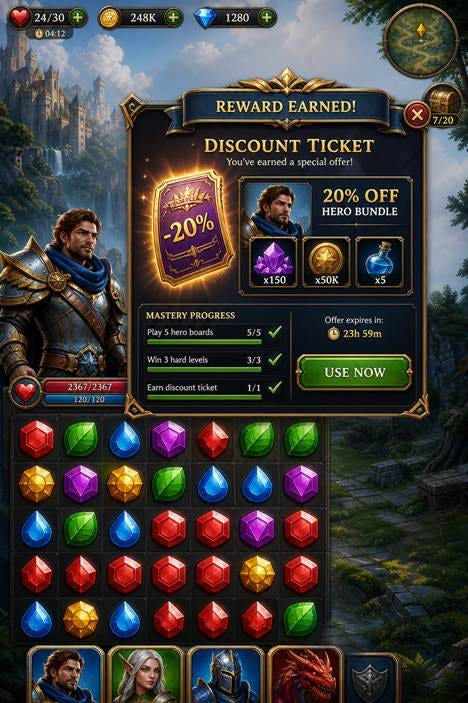
Mobile puzzle example: an earned discount ticket connected to regularity and mastery.
The most obvious version is discount earning.
A player completes milestones, reaches progression thresholds, participates in events, returns regularly, helps a guild complete a goal, plays a specific mode, or engages with a new feature. As a result, they earn a discount ticket, discount token, personalized offer reduction, store coupon, bundle modifier, or limited-time price improvement.
On the surface, this sounds simple: play more, get cheaper stuff.
But the better version is more nuanced. Discounts shouldn’t only reward activity. They should reward meaningful intent.
For example:
A player who upgrades the same hero repeatedly earns a discount on that hero’s premium skin.
A player who participates in a new mode earns a discount for a mode-specific starter bundle.
A player who returns for multiple days earns a limited discount on a reactivation bundle.
A player who contributes to a guild milestone earns a group-related offer.
A player who reaches a deep progression point earns a discount on a long-term convenience feature.
A player who tries a feature but doesn’t convert earns a second-chance offer that is cheaper, smaller, or more relevant.
This is much more interesting than general discounting because the discount becomes contextual. It’s tied to player behavior. It’s earned through interaction. It can feel like recognition instead of random price pressure.
The danger is also obvious.
If players learn that everything becomes cheaper by waiting, you have trained them not to buy. If players learn that weak engagement produces strong discounts, you have trained the wrong behavior. If players learn that discounts are fake, inflated, or always available, the system loses trust.
So, to avoid basic mistakes, discount earning should be designed around:
Specific behaviors
Clear eligibility
Real value
Limited frequency
Personal relevance
Non-destructive pricing
The discount should feel like the game saying:
You have reached a moment where this offer makes more sense now.
Not:
Please buy, we are lowering the price again.
Earning Subscription or VIP Access
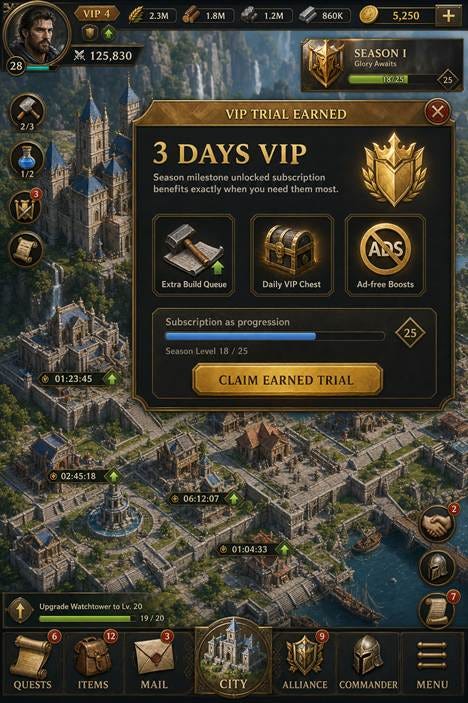
Mobile strategy example: a season milestone opening a VIP/subscription trial.
The second major opportunity is earning subscription and/or VIP access.
Most subscription systems are still built around a very static idea. Subscribe, get benefits. Pay monthly, receive the package. Upgrade tier, receive better package. Cancel, lose the benefits. That’s understandable. It’s clean commercially.
But, games can do something more dynamic because games already have progression systems, behavior data, social structures, and long-term engagement patterns.
Players could earn:
Temporary VIP access
Subscription trial days
Subscription tier openings
Reduced subscription entry prices
Upgrade eligibility
VIP streak protection
Partial subscription benefits
Group subscription rewards
Seasonal subscription boosts
Premium feature unlock periods
The important idea is that subscription doesn’t need to be only a purchase decision. It can also be a progression destination.
For example, a player could earn three days of VIP by completing a difficult event chain. Another player could unlock eligibility for a higher subscription tier only after reaching a certain account level. A guild could collectively earn a one-week VIP trial for members who contributed meaningfully during a season. A highly regular player could unlock a discounted monthly subscription offer because their behavior already indicates that the benefits would be relevant.
This changes the psychology of subscription. Instead of asking the player to imagine the value of VIP from outside the system, the game lets the player experience it from inside the system. This is effective because subscription value is often abstract before the player has lived with it. Daily rewards, faster progression, exclusive cosmetics, queue priority, extra slots, expanded storage, bonus missions, ad removal, premium event access, convenience features, and enhanced social tools can all look small when listed in a store. But, when those benefits touch the player’s actual routine, they become easier to understand.
This is especially powerful for regular players who have not yet monetized. They may not be unwilling to pay. They may simply not have had a reason that felt concrete enough.
Note: Interested about what I’ve covered about Regularity when it comes to finding more about regular players and their behavior? Check out my article here (https://gamesalchemy.substack.com/p/71-regularity):

Earned VIP access can create that reason without forcing the conversion too early.
Note: Interested to read what else I’ve covered relating to subscriptions? Check out these articles for starters:


Earning the Right to Buy
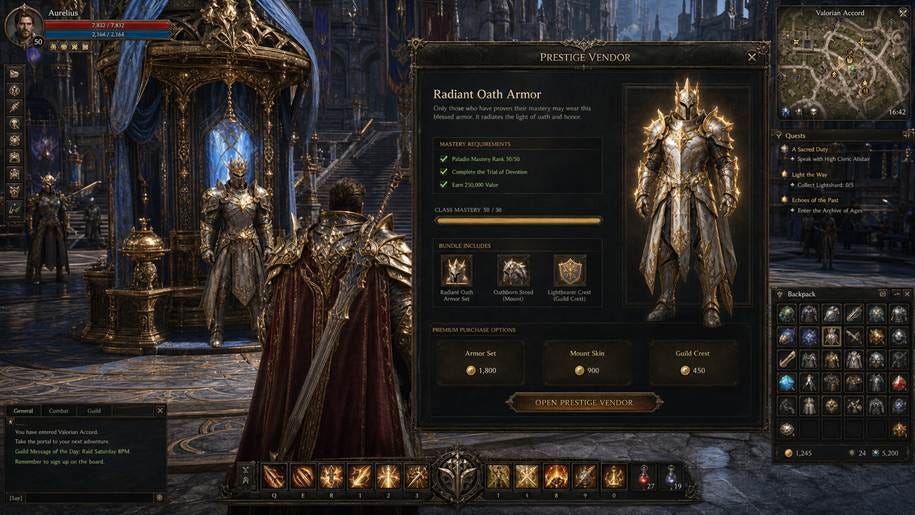
PC MMORPG example: mastery-based purchase rights for a prestige vendor.
Another underused model is earning purchase rights.
This can sound strange at first because most monetization design tries to reduce friction. If the player wants to buy, why make them earn the right to buy? But in some systems, earned purchase rights can increase perceived value, reduce store noise, and make monetized items feel more integrated into progression.
Examples:
A cosmetic becomes purchasable only after mastering the related character.
A prestige bundle unlocks only after reaching a season rank.
A founder-style offer opens only after participating in a new feature’s early period.
A high-value convenience item becomes available only after the player has reached the point where it actually solves a real problem.
A premium upgrade path opens only after a player has proven commitment to a mode.
A subscription tier becomes visible only when the player has outgrown the lower tier.
This isn’t about hiding monetization to be clever. It’s about sequencing monetization according to readiness.
Many games show players too much, too early. The store becomes a wall of unrelated commercial surfaces. The player sees offers for systems they don’t yet understand, cosmetics for characters they don’t care about, bundles for modes they haven’t adopted, and subscriptions for routines they haven’t built.
Earned purchase rights can make monetization feel less like a supermarket and more like an achievement path.
You played this. You mastered this. You joined this. You committed to this. Now this premium option is relevant.
That can be more elegant than constantly pushing the same offers to everyone.
Earning Better Store Logic
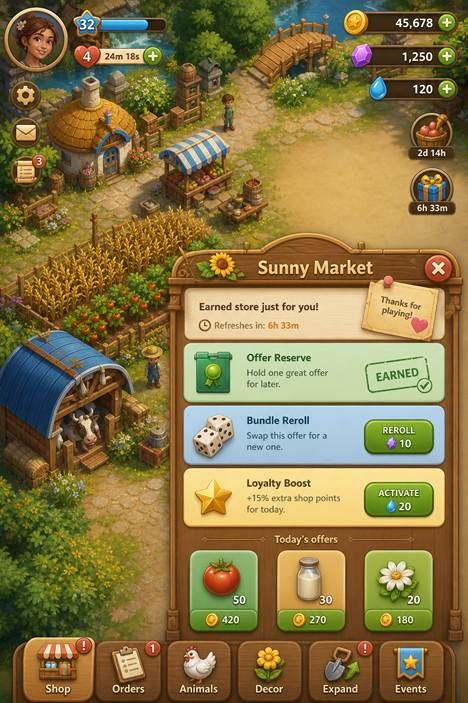
Mobile simulation example: earned store flexibility, offer reservation, rerolling, and loyalty boost logic.
Another way to think about this is that players can earn better store logic. Not just better prices. Better relevance.
For example, a player who has engaged deeply with one archetype shouldn’t see the same store as a player who rotates between many archetypes. A player who plays socially shouldn’t see the same offers as a solo optimizer. A player who values cosmetics shouldn’t be treated exactly like a player who values progression convenience. A player who comes back during events shouldn’t be treated exactly like a player with daily regularity.
The earning layer could unlock:
More relevant offer slots
More personalized bundles
Choice-based offers
Build-your-own bundles
Delayed payment windows
Loyalty multipliers
Store rerolls
Offer reservations
Upgrade paths
Trade-in systems
This is good because the player isn’t only earning an item. They’re earning a better commercial interface. For example, a player could earn the ability to reserve an offer for 48 hours. Another player could earn one monthly bundle reroll. Another could earn the right to convert an unused discount into a different category. Another could earn a loyalty multiplier on direct-to-consumer web store purchases, if the ecosystem supports it. This can make monetization feel more player-centric without simply lowering prices.
In many cases, flexibility may be more valuable than discounting. A player may not need a 20% cheaper bundle. They may need the bundle to contain the right character, the right currency, the right upgrade material, or the right timing.
Earned store logic can solve that.
Earning Monetized Features Temporarily
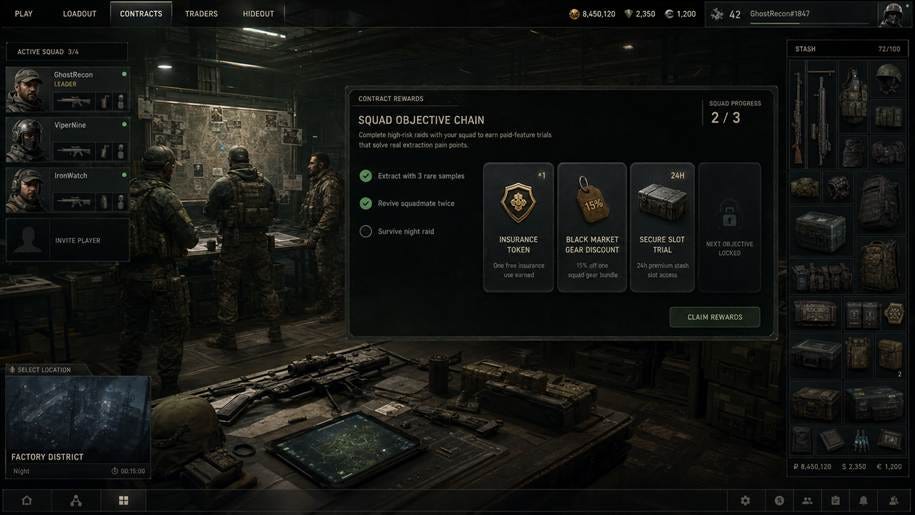
PC extraction shooter example: squad engagement unlocking insurance, gear discounts, and premium stash access.
Games can also let players earn temporary access to monetized features.
This is different from earning currency and different from earning a discount. The player earns the use of a feature that normally belongs to a paid layer.
Examples:
Temporary Ad removal
Extra inventory slots for a weekend
Premium queue access for an event
One-time auto-claim
One-week advanced analytics for strategy games
Temporary crafting acceleration
Extra loadout slots
Premium matchmaking filters
Additional social slots
Expanded guild tools
This can work well when the feature is hard to understand before use.
Some convenience features aren’t emotionally powerful in a store description. They become powerful only after the player experiences how they reduce friction. A temporary earned unlock can act as a playable demonstration.
But again, there is a design risk. Like, for example, if the temporary access is too generous, it may replace purchase. If it’s too weak, it may fail to teach value. If it’s given at the wrong moment, the player may not notice it.
The best timing is usually when the feature solves an active problem:
Don’t give extra storage before the player cares about storage.
Don’t give faster crafting before crafting has become a bottleneck.
Don’t give advanced guild tools before the player has a guild role.
Don’t give premium matchmaking filters before matchmaking quality matters.
Earned feature access should arrive when the player can feel the contrast.
Earning Social Monetized Value
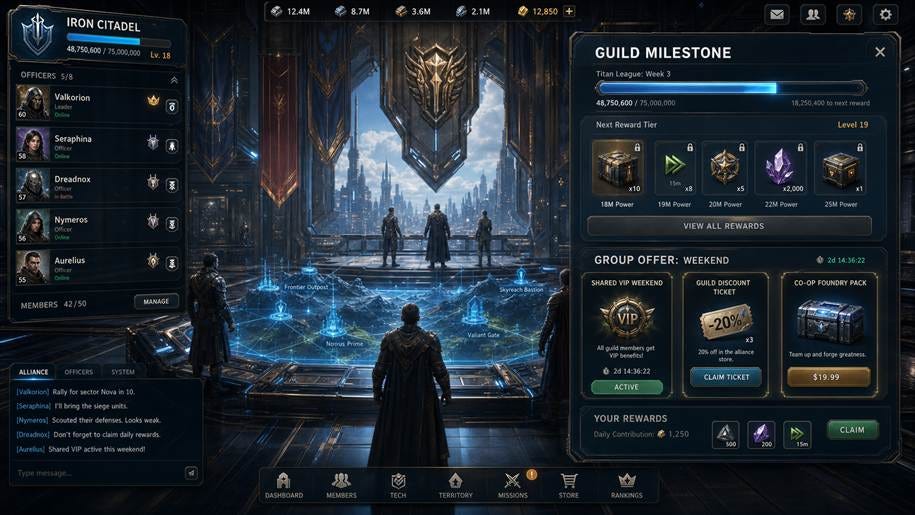
PC strategy/social example: guild engagement opening optional group offers without forcing social pressure.
There is also a social version of this, in which players can earn monetized value together.
This can include:
Guild discount tickets
Team store unlocks
Group subscription trials
Shared VIP weekends
Clan bundle eligibility
Co-op challenge coupons
Referral-based offer upgrades
Community milestone rewards
Spectator-driven boosts
Creator-linked store benefits
This has a different emotional texture than individual earning. When a group earns monetized value together, the offer can become part of the social story. The guild didn’t just earn resources. The guild earned access. The team didn’t just complete a task. The team opened a better commercial opportunity. The community didn’t just generate activity. The community changed the reward surface.
This is especially relevant for games with clans, guilds, alliances, parties, creator communities, and spectator ecosystems.
The key is to avoid turning social pressure into monetization pressure.
If one player’s payment is required for everyone else to benefit, the system can become socially uncomfortable. If the group earns the opening together and each player can choose privately whether to act on it, the system is cleaner.
The social layer should create relevance, pride, and timing. It should not create shame.
Note: Interested about social monetization itself? Check out what I’ve written about the topic in these articles:


Earning Payment Flexibility
One of the more interesting future directions isn’t earning cheaper value, but earning more flexible payment structures.
This can include:
Installment-style access
Prepaid subscription extensions
Delayed purchase windows
Trial-to-paid (upgrade) paths
Earned renewal protection
Tier upgrade credits
Pause-and-resume rights
Loyalty-based grace periods
Commitment discounts
Regional price-sensitive offer formats
This isn’t equally available on every platform, and developers need to work within e.g., platform, legal, tax, and consumer protection constraints. But, conceptually, the design space could be important.
Some players aren’t blocked by value. They’re blocked by timing, commitment, trust, liquidity, or uncertainty. An earned monetization system can respond to that.
A highly regular player might earn a better long-term subscription offer. A returning player might earn a prepaid VIP extension instead of an auto-renewing offer. A seasonal player might earn a one-season commitment price. A player who has already purchased several related items might earn a clean upgrade credit into a larger bundle.
This isn’t just pricing design. It’s relationship design.
The game is saying:
Because of how you engage, we can offer you a better structure.
That can be very powerful if done transparently.
Earning Through Meta Systems
The most natural home for this design isn’t always the store. It’s the meta.
Progression systems, achievement systems, mastery systems, collection systems, event systems, guild systems, battle pass systems, regularity systems, and long-term account systems are all better places to originate earned monetized value than the store itself.
Why? Because, the store is where the player evaluates the offer. The meta is where the player earns the meaning of the offer.
A discount earned through a mastery path feels different from a discount randomly shown in a pop-up. A VIP trial earned through a season milestone feels different from a generic free trial. A premium tier opening earned through long-term progression feels different from a store tab asking the player to upgrade on day one.
The same commercial value can feel completely different depending on where it comes from. This is why I think earned monetized value should be designed as a systems layer, not only a monetization tactic.
The earning source matters:
Gameplay mastery creates one meaning.
Progression depth creates another.
Regularity creates another.
Social contribution creates another.
Feature adoption creates another.
Seasonal participation creates another.
Comeback behavior creates another.
Each source can unlock a different kind of monetized value.
The Design Principle: Earned Relevance
The best version of this isn’t “earn discounts”. The best version is earned relevance.
A player should earn monetized value that makes sense because of who they’re becoming inside the game.
If they’re becoming a collector, they earn better collection offers.
If they’re becoming a competitor, they earn e.g., competitive cosmetic prestige and event access.
If they’re becoming a guild contributor, they earn group-related value.
If they’re becoming highly regular, they earn subscription opportunities.
If they’re becoming a mode specialist, they earn mode-specific premium openings.
If they’re becoming a returning player, they earn recovery paths.
If they’re becoming a creator, they earn e.g., creator-linked commercial tools.
This is more respectful than generic monetization because it listens to behavior. It also has likely better business logic because the offer is attached to demonstrated interest.
The player doesn’t receive value because the game wants to push revenue today. The player receives value because the game has observed a meaningful moment. That’s a much healthier foundation.
The Risks
There are real risks.
The first risk is discount dependency. If players learn that engagement always produces discounts, pricing discipline breaks.
The second risk is entitlement inflation. If every system gives monetized benefits, players may start seeing paid value as something that should always be earned for free.
The third risk is complexity. Too many tickets, coupons, trials, store modifiers, and unlock rights can make the economy harder to understand than it needs to be.
The fourth risk is unfairness. If some players receive better commercial opportunities without clear logic, others may feel punished.
The fifth risk is regulatory and platform friction. Subscription offers, discounting, auto-renewal, prepaid access, tiering, regional pricing, and external store ecosystems all have constraints. The design has to respect those constraints from the beginning.
The sixth risk is bad personalization. A personalized offer that feels relevant is good. A personalized offer that feels manipulative isn’t.
So, this means, that the system needs rules.
Earning systems should be:
Transparent enough to trust
Limited enough to protect price integrity
Contextual enough to feel relevant
Useful enough to teach value
Rare enough to feel earned
Simple enough to understand
Optional enough to avoid pressure
This isn’t a place for messy dark-pattern design. If anything, earned monetized value requires more care than normal store design because it sits closer to the player’s emotional relationship with the game.
Why Earning Monetized Value Matters
The future of game monetization isn’t only about inventing new things to sell. It’s also about inventing better ways for players to arrive at monetized value.
Many games still treat monetization as a separate destination. The player plays the game, then eventually gets sent to the store. The store tries to convert them. The game continues.
Stronger systems can make monetization part of the journey. Not in an aggressive way. In a more integrated way.
The game can say:
You played enough to understand this.
You progressed enough to need this.
You contributed enough to unlock this.
You returned enough to deserve this.
You specialized enough to want this.
You became regular enough for this to make sense.
That’s more interesting for a player than a static store. It’s also more human. Because, players don’t all reach monetization readiness at the same time, through the same motivations, or with the same needs. Some players need trust. Some need context. Some need proof. Some need social meaning. Some need timing. Some need flexibility. Some need to feel that the game recognizes their behavior. Earning monetized value can serve all of those needs.
The basic way is still valid. Let players earn currency. Let them spend it. Let the economy create clear paths between engagement and value. But don’t stop there.
There is a larger opportunity in letting players earn the monetized parts of the game more directly:
Discount tickets
VIP openings
Subscription trials
Premium tier eligibility
Store flexibility
Purchase rights
Temporary paid-feature access
Group offers
Upgrade credits
Offer reservations
Payment flexibility
Personalized commercial surfaces
These aren’t just monetization tricks. Designed well, they can become retention systems, regularity systems, loyalty systems, progression systems, social systems, and personalization systems.
The strongest version isn’t about making paid value cheaper. It’s about making paid value earned, contextual, and better timed.
And, if games are already systems for shaping behavior, progress, identity, and belonging, then monetization should probably learn to participate in those systems more smartly.